Product Testing & Quality Control

At Particle, we put a strong emphasis on testing. Our conservative approach allows us to have wheels thoroughly tested before they are ready for mass market.

All of our rims, spokes, hubs, and complete wheelsets are carefully and meticulously inspected every step along the production process before they are sent out.

Far Beyond the Industry Standard

Laboratory Testing

Each of our wheelsets undergoes more than two dozen performance, reliability, and safety tests before being released. All of our offerings go far beyond the UCI, ISO, and EN standards. In addition, all of our rims and wheels have undergone strict quality control throughout the production process.

Rim Testing

Rim trueness measures rotational accuracy. Wheels that are not true are weaker, have more variance in spoke tension, and can even wobble at high riding speeds. Making sure our rims are flat and round out of the molds leads to greater roundness and even spoke tension when building the rims into a wheel.

Lateral stiffness governs ride feel. A laterally stiff rim leads to a wheelset having better power transfer, making it perfect for competitive cyclists and sprinters. A laterally compliant rim contributes to a wheelset that feels more comfortable to ride, especially on not-so-smooth roads, making you less fatigued over time.

Radial stiffness testing is done to ensure the rim is vertically stiff enough to maintain its shape to ensure the tire can safely stay attached under high loads that go beyond the scope of what would be encountered when riding.

Spoke holes are the place on the rim where a spoke is threaded into a nipple and fixed in place at the rim side. This area is called the "nipple bed,” which needs additional reinforcement.

Rims that are poorly made are likely to crack at this high stress area due to the high amount of tension in the spokes.

Greenhouse test determines the thermal resistance and structural stability of rims under high-temperature conditions.

By simulating extreme levels of heat exposure, the greenhouse test ensures that rims maintain their structural integrity and performance even in extreme environments, such as prolonged sun exposure and/or high-friction braking scenarios.

This test is performed to ensure the airtightness of the rim. This is essential for tubeless-ready rims, as any air leakage can result in compromise performance, leadk g to pressure loss during and between rides.

We cut cross-sections of the rim to evaluate internal and external features. The purpose is to identify any possible irregularities, burrs, or deviations in dimensions of the rim to ensure it meets our standards.

Wheel Testing

Lateral stiffness governs ride feel. A laterally stiff wheel offers better power transfer, making it perfect for competitive cyclists and sprinters. A laterally compliant wheelset feels more comfortable to ride, especially on not-so-smooth roads, making you less fatigued over time.

We fine tune different wheels for people with different riding styles.

Radial stiffness testing is done to ensure the rim is vertically stiff enough to maintain its shape to ensure the tire can safely stay attached under high loads that go beyond the scope of what would be encountered when riding.

In order to ensure the rims are safe in case of high tire pressure, such as tire pressure increasing with an increase in temperature, we conduct this on each of our rims. Our standard is 150 psi with a 28c tire, which goes far beyond what would happen in everyday riding.

Unbalanced wheels and rims are prone to wobble at high speed, which undermines the controllability of the bike and wheels.We test the overall dynamic speed balance of our wheels for smoother rolling efficiency and solid road/tire contact.

The wheel fatigue test is designed to evaluate the durability and trueness of a complete wheel system under simulated riding conditions. It can reveal potential weaknesses in the rims, hubs, and spokes, and how they interact with one another. We use a load of 100kg and test the wheel for 5,000km.

The spoke tension and lateral runout must remain the same as before the test. Since we only use carbon spokes on our road and gravel wheels, spoke fatigue is not an issue.

Perhaps the most important test is the vertical impact test. It determines how safe a wheel is to ride in case of a collision, whether it be a pothole, a crash, or any other impact.

While the UCI vertical impact test is the industry standard at 40 joules, we think it is not strict enough. That is why all of our wheels must pass at least twice the requirement. In fact, with the exception of our climbing specific RCX27 Hyperlight wheelset, all of our wheels can survive 2.5-3.5x the UCI standard, ensuring you are safe when the unexpected happens.

While a rim may look fine at first glance, but if the rin hole drilling angles are off or if the nipple bed carbon layup isn’t consistent, the wheel will not be able to be built correctly.

Our rims must be built with tight tolerances, as we are using carbon spokes, which are not supposed to touch one another.

In order to determine the ease of mounting and dismounting the tire, we inspect tire/rim compatibility. We also check for possible brake track deformation due to inflation pressure.

The rim brake performance tests three things: stopping distance, peak brake force, and heat dissipation efficiency. This demonstrates how rim brake wheels will perform in real world riding conditions.

Hub Testing

This test measures the effects of acceleration, braking, and climbing translate into constant, and how they translate to repeated cyclical torsional loads on the hub. cyclical torsional loads on a bicycle's hub.

This test allows us to simulate years of use on the structural integrity and reliability of our hubs under extreme conditios conditions.

This test is designed to evaluate the durability and reliability of our hubs when they are exposed to rain, splashes, and moisture.

Our seals, labyrinth sealing, and double layer contamination barriers are all designed to make the hub as waterproof as possible.

The hub center hardness test is an important quality control examination which determines the material strength and durability of a hub.

By evaluating a hub's resistance to indentation, this test offers essential data and insight on the hub's ability to withstand operational stresses, namely torsional forces, bearing loads, and impacts.

The ratchet impact test simulates the intense conditions a hub's ratchet mechanism is subject to in real-world applications.

The ratchet mechanism receives strong impacts to assess its structural integrity, durability, and resistance to shock loading.

This test evaluates the structural integrity and load-bearing capacity of the hub's ratchet mechanism under prolonged use. Our ratchets are made of hardened steel, increasing durability.

Spoke Testing

We test the maximum spoke tension of our carbon spokes in order to evaluate how well they can withstand the forces of cycling.

They consistently are able to survive 4000 newtons of tension, as opposed to steel spokes that can survive just 2600-3200.

In order to evaluate the ride feel of our wheelsets and determine how they affect the stiffness of a wheel, we run spoke tension tests to see how they behave under different loads.

In order to provide riders with a choice, we offer both 3rd and 4th generation carbon spokes, which offer significantly different ride feel.

Our carbon spokes have been fatigue tested, simulating the effect of riding tens of thousands of kilometers in both road and gravel riding.

They do not fatigue over time like, which means they do not need to be re-trued and will not break under significant loads.

Still have questions? Drop us a line and get in touch.

Pro Team Testing

While lab testing is valuable, the truth is the it can only go so far. In order to completely test the performance, longevity, durability, and reliability of a wheelset, we believe that cooperating with UCI pro cycling teams is essential.

Pro teams formerly sponsored by other brands have experience riding wheels from different brands, allowing them to offer honest and constructive feedback about what works and what can be improved upon.

Teams have dozens of wheelsets that are each ridden for tens of thousands of kilometers per year under extreme conditions by some of the strongest riders in the world.

Our wheels are being ridden by Victoire Hiroshima, one of Japan's best UCI pro cycling teams, as well as Citymesh - Customm, one of Belgian's top women's teams. Victoire Hiroshima has won six races so far this season including the Tour de Kumano, a UCI 2.2 race. Citymesh -Cusomm has ridden in six UCI WorldTour events.

Quality Control

Carbon rims are usually handmade, and what sets apart a good quality rim from a mediocre one is complicated. Each rim factory employs their own quality control process and standards, quality of materials, and manufacturing techniques.

We are the only wheel brand we know of who provides a wheelbuilding report with every wheelset, with information including the tension of every spoke, as well as the lateral and radial runout. This let's you rest assured that your wheelset was built to the highest standards.

At Particle, we only partner with factories who are able to provide us with our high quality control standards, without cutting corners. Here is a partial list of the quality control checks our rims have undergone.

Carbon Layup

All of our carbon rims are made by hand using dozens of individually cut pieces of carbon fiber. This makes each individual rim unique.

We have strict weight limits on our wheels, ensuring they do not exceed 30g of the specified weight. In order to accomplish this, each rim must be within 15g of its own specified weight. If a rim exceeds this, it is rejected.

The truth is that not all carbon rims are made equal. Manufacturing processes vary significantly from factory to factory.

Our rims are manufactured in a way to essentially eliminate voids and wrinkles, allowing us to make extremely light rims that are also strong. There is no need to over engineer them, adding unnecessary weight.

While the manufacturing process of our rims is highly defined, we still inspect for wrinkles, voids, and contamination, as well as visual imperfections that take away from the aesthetics of the wheels.

After Molding

In order to ensure our rims are as strong as possible, we employ a second curing process to allow the prepreg to undergo the chemical reaction in its entirety. While most rims only undergo a single curing in the molds, ours undergo a second stage, being heated at a high temperature for an additional two hours.

In order to ensure each rim is safe when subjected to high pressure inflation, we install a 28c tire and inflate it to 150psi before the rims are surface treated. If a rim fails or if the lateral runout of the rim exceeds 0.2mm, the rim is rejected.

Each spoke hole is carefully inspected for excess resin. If there is resin present, it will be sanded down. This is to ensure spoke nipples sit properly.

While spoke hole inspection is an important step in our opinion, it is very time consuming and is often ignored by manufacturers in order to save costs.

If this isn't done a spoke may break through the resin while riding, resulting in a wheel to go out of true, which would cause a loss in traction and strength.

Final Inspection

We inspect rims to check whether there is any excess resin or particulate inside, as these can lead to noise when riding.

We are perhaps the only wheel brand to include a wheelbuilding report with each wheelset. The reason for this is to show you that your wheelset was built properly with correct spoke tensions and is within our strict lateral and radial trueness standards.

You can have peace of mind that your wheelset was properly built.

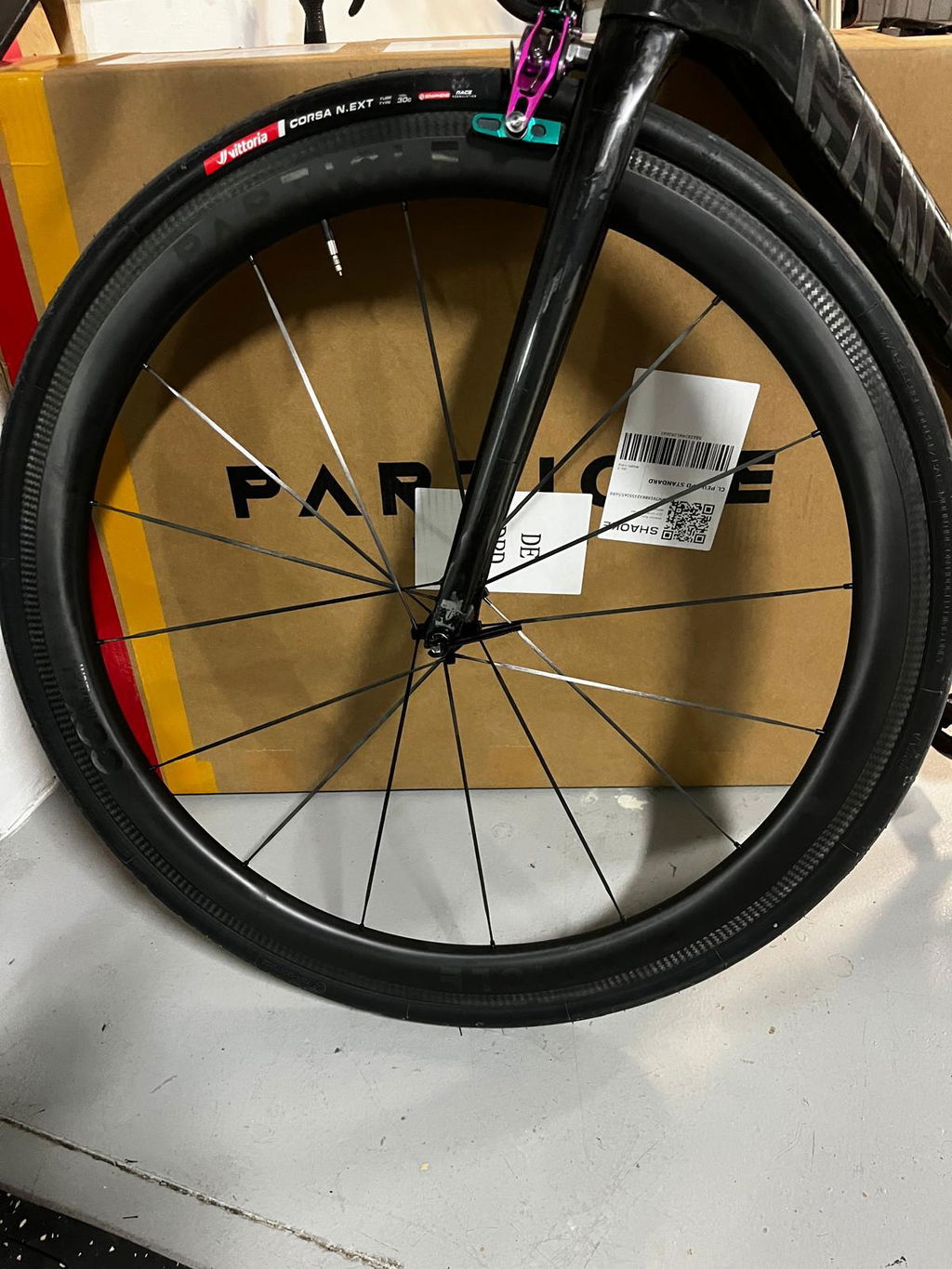
Before being sent out, each of our rims and spokes are visually inspected for potential defects or damage from handling. We take pictures of each wheelset before being sent out for our records.

Wheels are cleaned, ensuring they are spot free when you receive it.

Still have questions? Drop us a line and get in touch.