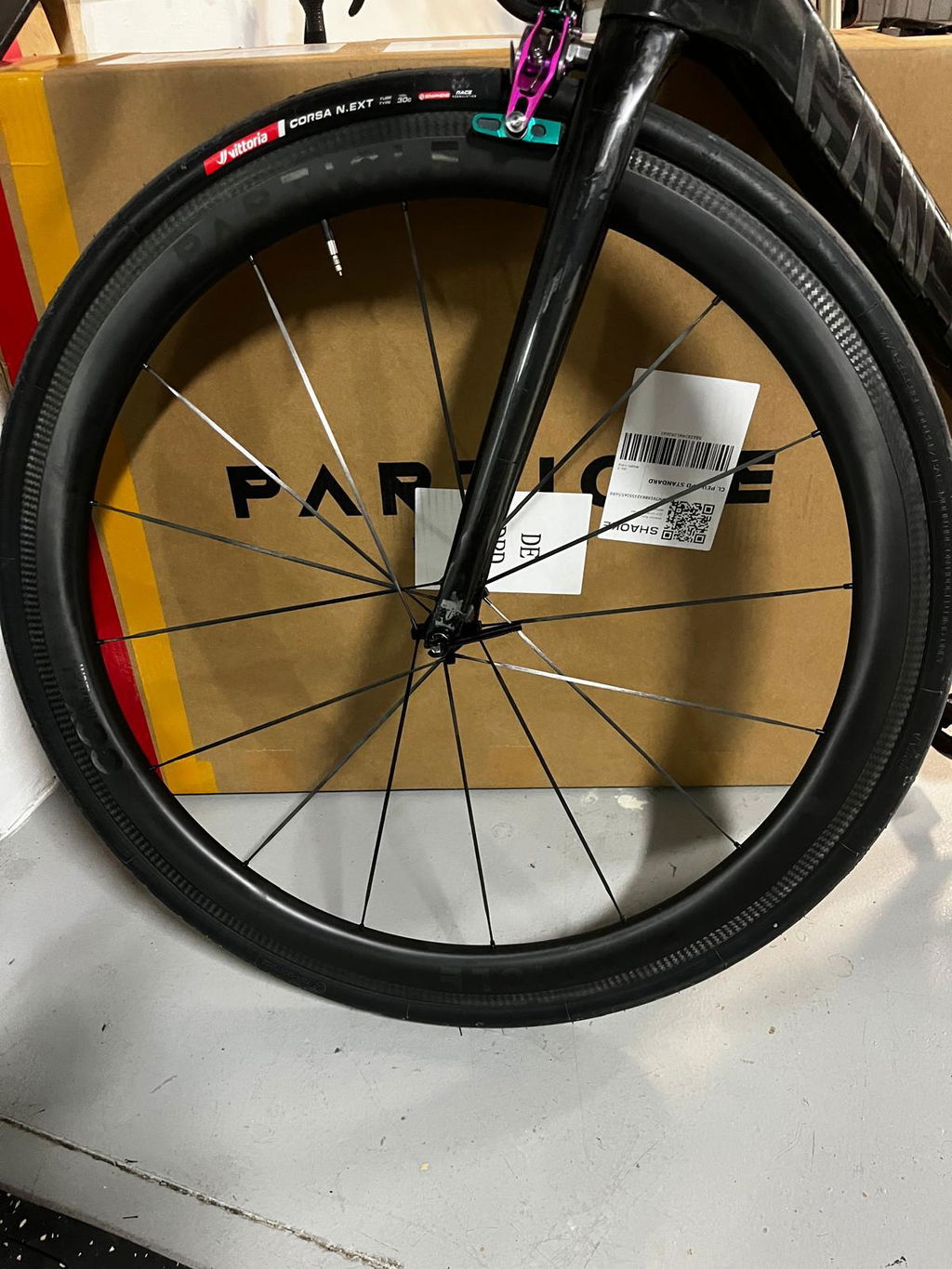
Carbon fiber wheels get praised for being light and fast, but the real engineering question is whether carbon rims can survive repeated hits, heavy loading, and years of use without losing structural integrity.
At Particle, we believe in going above and beyond standard benchmarks of durability while also displaying transparent data to help customers make informed decisions on their wheelset purchases.
The answer sits in the details: fiber orientation, resin system, wall thickness, rim profile, and how the wheelset is built and tested.
How Carbon Rims Are Engineered for Strength
Carbon Fiber Selection and Layup
Different fibers influence tensile strength, stiffness, and ride feel in different ways.
Some are chosen for high tensile resistance and load-bearing capacity, while others improve stiffness and reduce flex under spoke tension or cornering forces.
Alternating layers help spread energy across the rim rather than letting one section take the full hit, which is especially important for carbon wheels that see repeated stress on rough roads or mixed-surface rides.
Carbon Fiber Wheels: Rim Shape, Width, and Reinforcement Zones
Profile width changes more than tire fit. Wider rims support the tire sidewall better, which can improve cornering stability and reduce pinch-style impact issues at lower pressures.
Engineers also reinforce the spoke beds, bead hooks, and sidewalls because those areas see concentrated loads from spoke tension, tire pressure, and impact strikes.

Why Impact Resistance Matters for Carbon Fiber Wheels
What Happens During a Hard Hit
When a wheel takes a sharp impact, force travels through the rim and concentrates at weak points such as spoke holes, bead edges, or transitions in thickness.
Rims may crack, delaminate, or deform depending on how the energy spreads through the laminate.
Particle enforces a rigid check for internal voids and fiber wrinkling during assembly to ensure the layup maintains perfect material cohesion under sudden loading.
Impact Resistance vs. Stiffness
Stiffness and toughness are not the same thing.
Stiffness describes how little a wheel flexes under load, while toughness reflects how well it absorbs energy before damage spreads.
The stiffest wheel is not always the most durable wheel, and a very soft wheel is not automatically safer.
The best carbon wheelsets aim for a practical balance: enough stiffness for precise handling and efficient power transfer, plus enough toughness to survive real use without constant concern over failure after a hard hit.

Carbon Fiber Wheels Impact Test Methods Explained
Drop Tests and Strike Tests
Drop tests usually let a weight fall onto the rim or tire to mimic trail obstacles, potholes, or hard landings.
Strike tests can use a ram or shaped impact head to target a specific zone, such as the bead hook or sidewall.
While the standard UCI Vertical Impact Test requires surviving a 40-Joule strike, Particle pushes prototypes through a Maximum Survived Impact Test, proving our wheelsets can withstand 85 to 140 Joules depending on the specific model layout.
What Test Results Usually Measure
Common outputs include cracking, breakage, radial deformation, and lateral deformation.
Radial deformation is how much the rim changes up-and-down, while lateral deformation is side-to-side movement.
Particle rejects any rim displaying flatness or roundness deviations outside of a strict ±0.25mm lateral and radial runout tolerance baseline after stress-relieving procedures.

Strength and Durability Factors Riders Should Know for your Carbon Fiber Wheels
Marketing often highlights lightweight wheels or high tensile strength, but riders care about how a wheel survives months of use.
For carbon wheelsets, durability depends on more than the rim itself.
Spoke tension, nipple-bed strength, rim symmetry, and build quality all affect longevity.
A premium rim can still disappoint if the wheel build is uneven, while a smart build can make a durable wheel feel stable and trustworthy for years.
Spoke Tension and Wheel Build Quality
Even spoke tension keeps the wheel stable, helps preserve true, and reduces the chance of localized overloads at the nipple bed.
To combat this, Particle runs isolated Spoke High Tension Longevity and Spoke Hole Pull-Through testing alongside final factory stress-relieving procedures, ensuring the wheel arrives true for competitive athletes and everyday riders alike.

Fatigue, Wear, and Structural Soundness
Repeated loading is different from a single impact event.
Regular inspection matters because small chips, cracks, or spoke-bed changes can signal structural soundness issues long before a catastrophic failure.
For riders logging lots of miles, that habit is part of durability, not an optional extra.
Carbon Wheels vs. Alloy Wheels: Durability Tradeoffs
Carbon and alloy each bring different strengths to everyday riding. Carbon rims usually win on stiffness-to-weight ratio, ride precision, and aerodynamic shaping, which is why they are popular for road cyclists, gravel riders, and racers seeking lightweight wheels.
Alloy can still feel more forgiving in some impacts and is often easier to assess after a crash because dents are obvious.
Performance Differences That Matter
| Factor | Carbon Wheels | Alloy Wheels |
|---|---|---|
| Weight | Usually lighter | Usually heavier |
| Stiffness | Higher lateral stiffness is common | Often more flex |
| Ride feel | Precise and efficient | Slightly more forgiving |
| Damage visibility | Can hide internal damage | Often easier to inspect visually |
Which Material Handles Abuse Better?
A light strike that dents alloy may do little to a strong carbon rim, while a sharp edge impact can be especially punishing to either material depending on shape and severity. Riders who regularly hit square edges, carry heavy loads, or ride far from service access may value different tradeoffs than racers focused on speed. Use case, maintenance habits, and appetite for inspection should guide the decision.
How to Tell if Carbon Wheelsets Are Durable Enough
Specs and Certifications to Look For
Check impact standards, rider weight limits, and whether the wheelset is intended for road, gravel, or mountain use. Particle wheelsets go far beyond standard UCI, ISO, and EN benchmarks, ensuring every model can survive vertical hits at least 2x the standard UCI impact test. Look for transparent brands that specify conservative, safe weight limits alongside comprehensive 3-year standard factory warranties covering rims, hubs, and spokes.
Visual and Build Clues
Look for reinforced spoke beds, smooth bead areas, and consistent wall thickness around the rim. Tight machining tolerances, clean finish work, and evenly placed laser engraved decals often suggest a more controlled production process. Irregular surfaces or sloppy finishing do not automatically mean poor durability, but they can hint at inconsistent manufacturing discipline. For first-time buyers and experienced riders alike, visual clues should support, not replace, published data and warranty terms.
Care Tips to Extend Carbon Rim Lifespan
Post-Ride Inspection Habits
After rough rides, check rim edges, spoke areas, and bead seats for chips or marks. If anything looks uncertain, a professional inspection is worth the time. That is especially true for riders using carbon road wheels or carbon gravel wheels in mixed conditions.
Riding Practices That Reduce Damage
Avoid chronic underinflation and repeated square-edge hits when possible, since both raise the chance of impact damage. Tire pressure that is too low can let the rim take more of the strike, while a smarter pressure setup helps the tire absorb part of the load. Every Particle configuration undergoes a structural 130 PSI tire pressure inflation check during production to verify edge integrity.
Choosing Carbon Wheels With Confidence
The strongest rims are not defined by the boldest claim on a product page. They come from careful layup design, targeted reinforcement, repeatable impact test methods, and a wheel build that keeps spoke tension in balance. Riders comparing carbon wheelsets should weigh impact tolerance, stiffness, warranty coverage, and build quality together. Particle backs this engineering process with a 3-year warranty covering the entire wheel system—with extended 5-year and lifetime options available to protect your rims over the long haul—alongside a lifetime crash replacement policy, ensuring your investment is always protected.